Quick Summary
- The BC early learning framework serves as the province’s progressive pedagogical guide, viewing children as naturally capable, curious, and full of potential.
- Grounded in modern developmental neuroscience, play based learning transforms everyday curiosity into critical cognitive, social, and linguistic architecture.
- The framework is anchored across four foundational pillars: Well-Being and Belonging, Exploration and Creativity, Languages and Literacies, and Social Responsibility.
- Modern early learning classrooms abandon rigid memorization worksheets in favour of open-ended, sensory-rich investigations that nurture genuine school readiness.
- Sandbox Station Childcare Centre aligns its specialized Preschool Program (3–5 Years) with these provincial standards, delivering trusted and compassionate early education in Surrey, BC.
Introduction
When many parents picture an early learning classroom, memories of their own school days often come to mind: seated desks, repetitive letter-tracing worksheets, and teacher-directed instruction. However, early childhood education across Canada has undergone a profound, research-backed revolution. Today, the BC early learning framework stands as British Columbia’s official pedagogical vision, fundamentally redefining how certified educators understand, nurture, and inspire young minds. Rather than treating children as empty vessels waiting to be filled with rote facts, this visionary standard recognizes that young learners are naturally capable, inventive, and deeply inquisitive individuals who make sense of the world through active discovery. For families navigating early schooling options across the Lower Mainland, choosing a program built upon this framework ensures that their child’s intellectual, emotional, and social growth is supported by world-class developmental standards. Finding an enriching preschool program in Surrey BC that embraces these principles allows parents to give their little one an exceptional start in life. At Sandbox Station Childcare Centre, our Preschool Program (3–5 Years) is thoughtfully designed around provincial guidelines, creating a vibrant space where children build lifelong confidence, resilience, and curiosity through the transformative power of purposeful play.
Unlock your child’s natural curiosity and set the stage for lifelong learning through our purposeful, play-centered curriculum :
1. The Core Philosophy: Reimagining the Capable Child
At the heart of the early learning framework BC guidelines is a refreshing, empowering image of the child. The framework challenges outdated educational models that view young children merely as future students who must be drilled to sit still. Instead, it honors childhood as a vital phase of life in its own right.
Child Curiosity & Agency ➔ Educator-Scaffolded Provocations ➔ Active Hands-on Inquiry ➔ Enduring Neural Connections
Under this provincial approach to BC early learning, children are seen as active co-constructors of their own knowledge. They arrive at the classroom door already carrying unique personal histories, cultural backgrounds, languages, and creative perspectives. When educators validate their ideas, listen to their questions, and allow them to take age-appropriate risks, children develop a profound sense of agency. This intrinsic motivation to explore is the single greatest engine for lifelong academic and personal fulfillment.
2. Play as the Ultimate Engine of Brain Architecture
A frequent question parents ask during facility tours is simple: “If children are just playing, how are they actually learning?”
Decades of developmental neuroscience confirm that play based learning is not a break from education; it is the most biologically sophisticated form of learning the human brain can experience. During early childhood, the brain constructs more than one million new neural connections every second. Repetitive drills and passive screen time activate only narrow, surface-level pathways. Conversely, multi-sensory, open-ended play illuminates the entire brain simultaneously.
The Hidden Depth of Playful Exploration
Consider the rich cognitive processes taking place in an intentional play-based classroom:
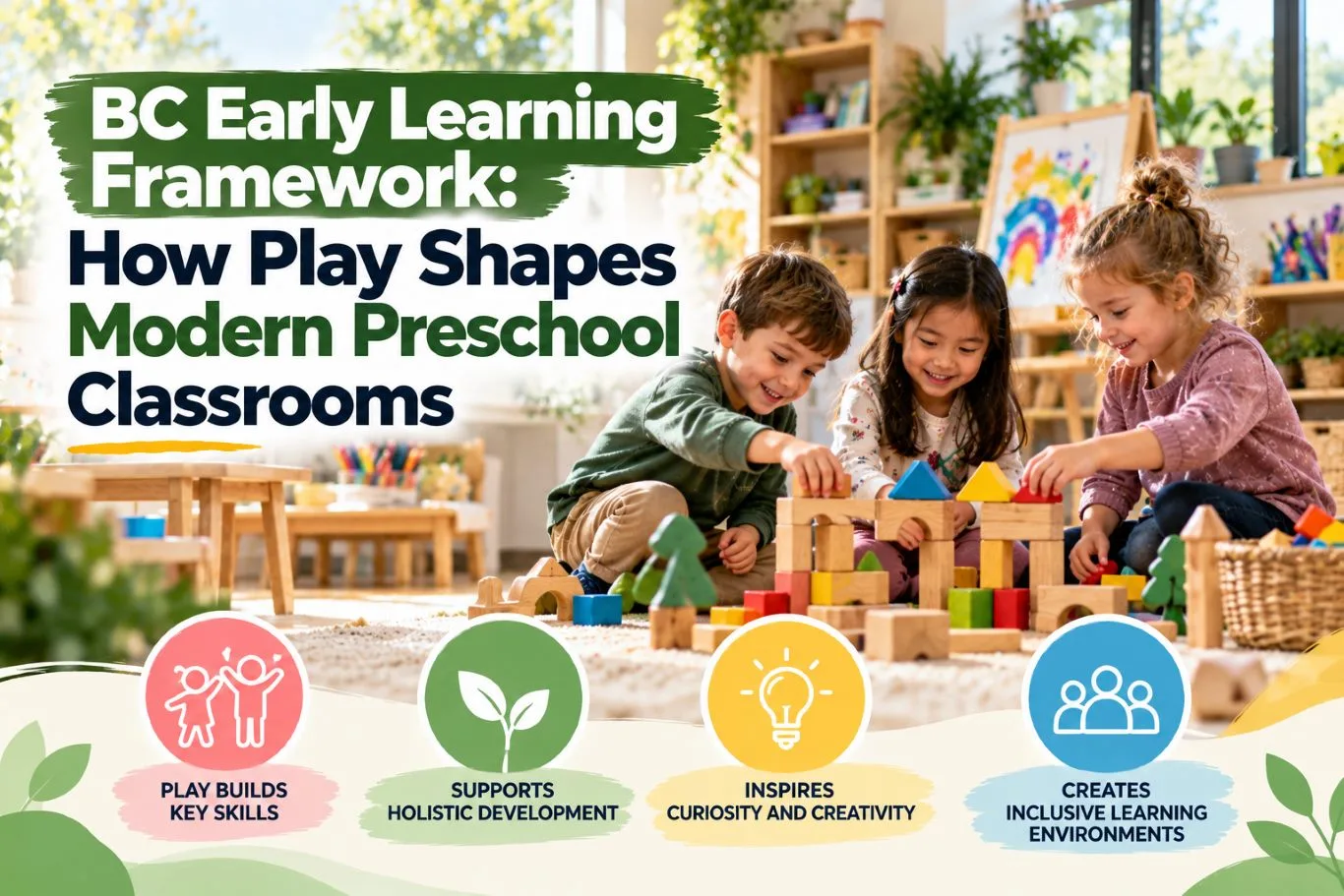
- Tactile Construction with Unit Blocks: When children balance wooden arches and rectangular blocks, they are engaging in practical geometry, understanding gravity, testing structural balance, and practicing spatial calculation.
- Water and Sand Table Experiments: Scooping water through funnels and watching damp sand hold its form introduces early scientific hypothesis testing, volume perception, and density concepts.
- Sensory Art and Clay Work: Molding clay and cutting paper fringing strengthens the delicate hand and finger muscles required for a comfortable, fatigue-free pencil grip later in Grade Primary.
Through preschool learning through play, abstract concepts become physical, tangible realities that children can see, touch, and understand intuitively.
3. The Four Core Pillars of the BC Preschool Curriculum
The BC preschool curriculum framework organizes learning into four interconnected, holistic areas of development. These pillars guide certified Early Childhood Educators (ECEs) as they observe, reflect on, and plan daily classroom environments:
┌────────────────────────────────────────────────────────┐
│ BC Early Learning Framework │
├───────────────────────────┬────────────────────────────┤
│ Well-Being and Belonging │ Exploration and Creativity │
├───────────────────────────┼────────────────────────────┤
│ Languages and Literacies │ Social Responsibility │
└───────────────────────────┴────────────────────────────┘
Pillar 1: Well-Being and Belonging
A child’s brain cannot absorb new cognitive skills if they feel anxious, insecure, or disconnected. This pillar prioritizes:
- Establishing secure, loving attachments between children and their educators.
- Fostering an inclusive environment where every family’s cultural heritage, language, and traditions are honored and visible.
- Supporting physical health, restful sleep habits, nutritious eating, and strong emotional self-regulation through gentle co-regulation.
Pillar 2: Exploration and Creativity
Children are natural scientists and artists. This domain encourages:
- Open-ended inquiry where there is no single “correct” way to use materials.
- Hands-on experimentation with natural elements such as leaves, pinecones, wood, and stones.
- Fostering divergent thinking—the ability to look at an everyday challenge and brainstorm multiple inventive solutions.
Pillar 3: Languages and Literacies
Literacy is far broader than simply reciting the ABCs. The framework embraces multiple modes of expression:
- Dialogic storytelling, where educators and children analyze book characters, predict plot twists, and explore rich descriptive words.
- Musical rhythm, rhyming games, and phonetic songs that build phonological awareness.
- Symbolic representation through drawing, dramatic play, movement, and sign language.
Pillar 4: Social Responsibility
Developing empathy, fairness, and care for the community is foundational to human growth. This pillar focuses on:
- Learning to negotiate peer boundaries, share resources, and resolve interpersonal conflicts with respectful words.
- Cultivating a deep respect for the natural environment through daily outdoor exploration and recycling practices.
- Honoring Indigenous worldviews, particularly the connection between people, local lands, and living creatures.
4. Play-Based Learning vs. Traditional Academic Classrooms
Understanding how play based preschool programs differ from traditional, academic-driven childcare models helps parents appreciate the developmental advantages of modern early childhood education:
| Educational Dimension | Traditional Academic Daycares | Play-Based Classrooms (BC Framework) |
| Classroom Instruction | Teacher-directed; children follow uniform steps at a set pace. | Child-inspired and educator-scaffolded; responsive to children’s organic curiosity. |
| Learning Materials | Closed-ended materials like photocopied worksheets and flashcards. | Open-ended sensory materials, loose parts, natural elements, and building blocks. |
| Motivation Driver | Extrinsic motivators like gold stars, grades, or teacher praise. | Intrinsic drive rooted in curiosity, personal discovery, and collaborative joy. |
| Social Dynamics | Emphasizes individual seatwork and quiet compliance. | Encourages conversational dialogue, peer negotiation, and collaborative projects. |
| Curriculum Structure | Rigid schedules centered on memorizing abstract facts. | Flexible inquiries adapted to local community seasons and emergent interests. |
5. The Role of the Educator: Scaffolding, Not Directing
In a modern, progressive preschool classroom, the educator’s role is far more nuanced than simply telling children what to do. Certified ECEs act as attentive researchers and supportive mentors.
The Art of Scaffolding
Educators utilize a pedagogical strategy known as “scaffolding.” When an educator observes a small group of preschoolers struggling to build a ramp steep enough for toy cars to roll across the rug, they do not step in to solve the puzzle for them. Instead, they sit at the children’s eye level and offer thoughtful, open-ended provocations:
- “I notice the car stops right at the bend. What do you think would happen if we raised this side of the board?”
- “Which block do you think is taller to hold up the end?”
By asking intentional questions, the educator prompts the children to think critically, test their hypotheses, and experience the pride of solving the problem themselves.
Pedagogical Documentation
Educators continuously record children’s daily discoveries through photographs, transcribed quotes, and observational notes. Displaying this documentation on classroom walls makes learning visible to the children themselves, reinforcing their memory and providing parents with an authentic window into their child’s cognitive journey.
6. How Play Prepares Children for Long-Term School Success
Parents sometimes worry that a play-centered preschool experience will leave their child unprepared for the academic structure of kindergarten and elementary school. In reality, modern kindergarten teachers consistently emphasize that the skills cultivated through play are precisely what children need to excel in formal school.
When a preschooler spends their early years immersed in rich, self-directed play, they develop essential executive functioning skills:
- Working Memory: Remembering multi-step rules while playing collaborative games with peers.
- Cognitive Flexibility: Adapting when a block structure collapses or when a peer suggests a new direction for a game.
- Inhibitory Control: Resisting impulses, waiting for turns, and sustaining focus on a task despite classroom distractions.
Children who master these foundational executive skills enter the public school system as resilient, adaptable, and self-directed learners who can easily absorb formal reading, writing, and mathematical lessons.
7. Connecting Children to Nature: Outdoor Play in the Pacific Northwest
A vital component of early childhood education BC guidelines is the emphasis on outdoor learning. British Columbia is blessed with breathtaking natural landscapes, and the framework encourages educators to treat the outdoors as an extension of the classroom.
Rain or shine, children are encouraged to put on waterproof boots and mud suits to experience the natural environment directly:
- Splashing in puddles and running on uneven grass builds physical balance, vestibular coordination, and gross motor strength.
- Observing bugs under rotting logs, watching leaves change color, and listening to native birds sparks an authentic love for ecology.
- Spending unhurried time outdoors lowers stress levels, calms sensory overstimulation, and instills a deep sense of environmental responsibility.
A Welcoming Early Learning Space for Surrey Families
Surrey is an energetic, fast-growing city where modern working parents need a dependable, customer-focused childcare partner. From the quiet suburban neighbourhoods of Fleetwood and Clayton Heights to the active corridors of Guildford and North Surrey, parents want an early childhood program that combines warmth with proven educational quality.
Choosing a reputable licensed daycare in Surrey BC that actively grounds its daily programming in provincial standards gives families complete peace of mind. Providers like Sandbox Station Childcare Centre are dedicated to creating a safe, inclusive, and joyful community for young explorers. Our certified educators understand how to translate natural curiosity into meaningful developmental milestones, ensuring that your little one’s early learning journey is safe, inspiring, and full of wonder.
FAQs for Local Parents
Q1: How does play-based learning teach early reading and math skills?
A1: Play-based learning integrates early academics through practical, tactile experiences. Children build pre-reading phonemic awareness through songs, rhyming books, and storytelling, while exploring early math through pattern sorting, block counting, and measuring water and sand at sensory tables.
Q2: What is the main difference between the BC Early Learning Framework and Montessori or Reggio Emilia?
A2: The provincial framework draws inspiration from world-renowned approaches—including Reggio Emilia and progressive early childhood research—while tailoring its principles directly to the cultural diversity, inclusive values, and natural geography of British Columbia.
Q3: What neighborhoods do you serve, and how quickly can we arrange a preschool tour?
A3: We welcome families from all across Surrey and surrounding Lower Mainland communities. Because licensed preschool spots are in high demand across the region, we prioritize responsive local communication and aim to answer all tour and waitlist inquiries within 24 to 48 business hours.
Q4: Will my child have quiet rest time during a full-day preschool program?
A4: Yes. Full-day licensed preschool and multi-age programs incorporate a designated quiet rest period after lunch. Children are provided with a cozy, comfortable cot to nap or enjoy quiet, relaxing activities like reading picture books to recharge their energy.
Q5: Are preschool programs in British Columbia eligible for provincial fee reductions?
A5: Yes. Fully licensed childcare programs participate in the Child Care Fee Reduction Initiative (CCFRI), which automatically reduces monthly parent fees on your invoice, and eligible families can apply for the income-tested Affordable Child Care Benefit (ACCB) for additional financial support.
Conclusion: Fostering a Lifelong Love of Learning
The early years are a precious window of rapid intellectual, emotional, and social discovery. By choosing an early childhood environment built upon the BC early learning framework, you give your child an educational setting that honors their individuality, nurtures their natural curiosity, and builds genuine self-confidence through joyful play.
When you partner with an early learning center that blends provincial excellence with authentic warmth, daily drop-offs become moments of shared confidence. If you are searching for an exceptional early childhood foundation and a supportive community for your child, Sandbox Station Childcare Centre is ready to welcome your family. We are deeply proud to provide the trustworthy, accessible, and high-standard early childhood programs that Surrey parents rely on, ensuring your child’s preschool years are safe, enriching, and filled with joy.
Discover how our play-based preschool environment can unlock your child’s full developmental potential today.
Make the informed choice today that sets the foundation for your child’s bright, confident tomorrow.