Quick Summary
- Discover the science behind a play-based daycare in Surrey BC and how it builds critical brain architecture before kindergarten.
- Understand the fundamental differences between rigid, worksheet-heavy models and intentional, play-centered learning.
- Learn how child-led play strengthens social-emotional intelligence, problem-solving, and resilience.
- Explore how professional early childhood settings align with the provincial BC Early Learning Framework.
- See how Sandbox Station Childcare Centre subtly combines educational quality and affordability to support Lower Mainland families.
Introduction
Watch a group of young children playing together, and you might think they are simply enjoying a break from the challenges of learning. One child is building an elaborate tower out of wooden blocks, another is pretending to cook a meal in a miniature kitchen, and a third is completely absorbed in mixing water and sand. To the untrained eye, this looks like pure recreation. To an expert in early childhood development, however, these children are deeply engaged in high-level intellectual work. They are testing the laws of gravity, negotiating complex social boundaries, and expanding their vocabularies. For parents living across the Lower Mainland, the transition from home care to a formal setting brings up a crucial question: how do young children learn best? The global research points to a clear answer—a high-quality play-based daycare in Surrey BC provides the most effective foundation for early cognitive, emotional, and social development. Finding a balance between rigorous educational principles and family budgeting can be a challenge, making the search for affordable childcare in Surrey BC a primary focus for modern households. At Sandbox Station Childcare Centre, we have designed our licensed programs around the understanding that play is not a distraction from early education; it is the absolute engine of human development.
Give your little one a nurturing space to master essential social tools, resilience, and problem-solving through joyful daily play :
Clarifying the Concept: What is Intentional Play-Based Learning?
A common misconception among parents is that a play-based philosophy means a complete lack of structure, where children run around aimlessly while adults simply monitor the room for safety. In professional early childhood education, this could not be further from the truth. True play-based learning is a highly sophisticated, intentional pedagogical approach.
In a play-centered classroom, certified Early Childhood Educators (ECEs) act as architectural designers of the environment. They do not stand at the front of a room lecturing or forcing toddlers to fill out repetitive color-by-number worksheets. Instead, they carefully stage different “learning areas” or “provocations” using open-ended materials. The curriculum is emergent, meaning it follows the genuine interests and developmental stages of the children. If a group of children becomes fascinated by the rain puddles outside on a typical BC morning, a professional educator will introduce clear measuring cups, pipettes, and floating objects into the sensory table. This seamlessly transforms their natural curiosity into an early scientific exploration of volume, density, and liquid physics.
The Cognitive Blueprint: How Play Shapes the Developing Brain
During the first five years of life, a child’s brain forms more than one million new neural connections every single second. This intense neurological growth is driven entirely by how a child interacts with their physical surroundings and their primary caregivers.
1. Problem-Solving and Scientific Reasoning
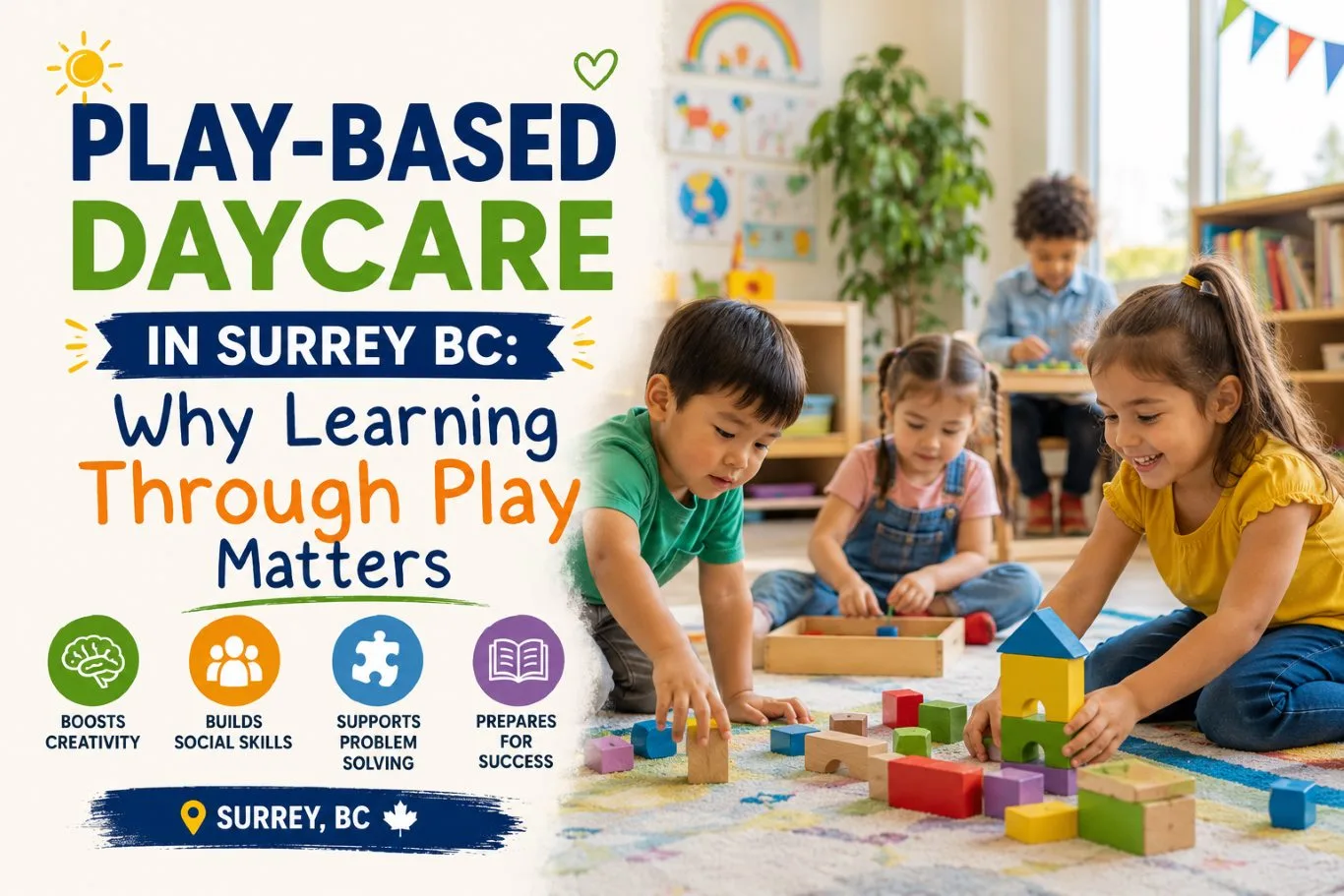
When a child plays with open-ended blocks, they are constantly experimenting with spatial geometry and physics. If a structure topples over, they face a choice: give up or try a new approach. A professional educator in a play-based setting will not rush in to correct the mistake. They will ask supportive questions like, “What do you think would happen if we used a wider block for the foundation?” This approach guides the child to form a hypothesis, test it, analyze the outcome, and build resilient critical-thinking skills.
2. Linguistic Expansion and Pre-Literacy
Language acquisition happens rapidly when words are tied directly to meaningful physical actions. In a play-based classroom, children are constantly communicating. Whether they are negotiating who gets to carry the blue bucket or describing the magical castle they are drawing, they are actively using language in real-world contexts. Educators build on this by introducing high-quality vocabulary words during play, mapping spoken sounds to letters through interactive storytelling, and cultivating phonemic awareness without relying on rigid memorization.
3. Early Math and Quantitative Logic
Early mathematics is an intensely physical experience for a young mind. Long before a child can comprehend abstract numbers written on a chalkboard, they understand math through their hands. Sorting plastic buttons by size, arranging colored stones into repeating patterns, or counting out the exact number of cups needed for a group snack time are all foundational math concepts. Play-based daycare environments make these mathematical relationships clear, tangible, and highly engaging.
Social-Emotional Intelligence: The Core Foundation for Life
While academic milestones often capture a parent’s attention, emotional intelligence is the true predictor of long-term life success. It is significantly easier to teach a child to read or write when they are older than it is to teach them how to empathize with a peer, manage frustration, or collaborate within a group.
- Self-Regulation: Young children experience massive emotions but lack the neurological wiring to manage them independently. In a play-based setting, conflicts over toys or territory are handled as vital learning opportunities. Educators use co-regulation strategies, helping children name their feelings and find calm, pro-social ways to resolve differences.
- Empathy and Role-Play: Dramatic play areas allow children to step into someone else’s shoes. Playing the role of a parent, a veterinarian, or a firefighter helps young minds naturally develop empathy, explore different perspectives, and practice advanced non-verbal communication skills.
- Resilience and Adaptability: Unstructured and scaffolded play is full of small, manageable challenges. When a game changes direction or an art project does not look exactly as intended, children learn how to adapt, negotiate rules, and try again, building a growth mindset that serves them throughout their eventual school years.
The Environment as the “Third Teacher”
In professional early learning circles, the physical classroom is often referred to as the “third teacher” (following the parents and the educators). A premier play-based center prioritizes organic, open-ended materials over flashing electronic toys that leave little room for imagination.
A block of wood can become a telephone, a racecar, a piece of cake, or a skyscraper depending on a child’s imagination. A plastic toy that plays a pre-recorded sound when a button is pressed can only ever be one thing. By curating clean, beautiful spaces filled with natural light and raw materials like clay, textiles, sand, and wood, professional settings reduce sensory overload, increase concentration spans, and empower children to drive their own educational journey.
Alignment with the BC Early Learning Framework
British Columbia is recognized globally for its forward-thinking approach to early childhood development. The provincial government’s official BC Early Learning Framework explicitly rejects rigid, standardized milestones in favor of a holistic, play-based approach that views children as capable, creative, and full of potential.
The framework focuses heavily on four primary areas:
- Well-being and Belonging: Ensuring every child feels physically safe, emotionally cherished, and culturally represented within their daily community.
- Exploration and Creativity: Fostering a deep connection to the natural world, scientific inquiry, and open-ended artistic expression.
- Languages and Literacies: Supporting all forms of human communication, from spoken words and signs to movement, drawing, and music.
- Social Responsibility and Justice: Helping young children learn to care for their local environment, practice fairness, and contribute positively to their group.
When you select a licensed daycare that operates strictly within this modern framework, you ensure your child’s daily care matches the absolute highest educational standards in Canada.
Easing the Transition to Kindergarten
A common question parents ask is: “If my child spends their days playing, how will they be ready for the structure of Grade 1?” The reality is that children who come from rich, play-based early environments adjust to formal schooling with far greater ease.
Kindergarten readiness is not about a child being able to sit perfectly still at a desk for hours at a time. True readiness means having the confidence to ask questions, the fine motor strength to hold a pencil comfortably, the social capacity to make friends, and the emotional resilience to handle a full school day without intense separation anxiety. Play-based care addresses all of these foundational needs, ensuring children enter the school system as active, enthusiastic participants rather than passive observers.
Choosing a Professional Support System in Surrey
Surrey is a fast-evolving city populated by hardworking families who need a dependable, professional support network. From the quiet residential lanes of Cloverdale to the bustling centers of North Surrey, managing the daily balance between career commitments and family life requires a local partner you can trust implicitly.
Providers like Sandbox Station Childcare Centre understand the unique logistical and financial needs of families living in the Lower Mainland. We prioritize delivering a highly reliable, consistent, and customer-focused environment across our licensed settings. By utilizing modern play-based strategies, we ensure your child receives the highest caliber of professional care, allowing you to focus on your day with absolute emotional confidence.
FAQs for Lower Mainland Parents
Q1: What is the main difference between “free play” and “scaffolded play” in a daycare?
A1: Free play is completely unstructured with no adult involvement. Scaffolded play is a technique where trained ECE professionals observe the child’s self-directed play and intentionally introduce open-ended questions, new materials, or challenges to deepen the cognitive and linguistic learning taking place.
Q2: How do you ensure physical safety during active outdoor play?
A2: Fully licensed facilities are governed by strict Fraser Health supervision regulations. Outdoor play yards feature secure fencing, impact-absorbing ground materials, and age-appropriate equipment. Educators are trained in active supervision, positioning themselves to scan all play areas continuously.
Q3: What neighborhoods do you serve, and what is your enrollment availability?
A3: We proudly welcome children from all across Surrey and nearby BC areas. Because demand for licensed, high-quality early childhood spaces across the Lower Mainland is consistently high, our room availability changes dynamically. We encourage families to connect with us early to check our current opening schedules.
Q4: What is your standard turnaround time for responding to new local inquiries?
A4: We understand how stressful it can be to coordinate childcare alongside work returns or school deadlines. At Sandbox Station Childcare Centre, we maintain a highly efficient local communication pipeline and aim to respond to all enrollment, waitlist, and tour inquiries within 24 to 48 business hours.
Q5: Are play-based daycare programs eligible for BC provincial fee reductions?
A5: Yes. Fully licensed childcare facilities participate in the Child Care Fee Reduction Initiative (CCFRI), which automatically applies substantial government discounts to your monthly statement, keeping premium early education accessible and affordable.
Conclusion: A Trustworthy Launchpad for the Future
The early years of a child’s education pass by in what feels like the blink of an eye, but the structural blueprints established inside their mind during this fleeting window will guide them for the rest of their lives. Opting for a certified, play-based model is a conscious choice to honor the natural, time-tested way the human brain is wired to learn. It builds an enduring foundation of curiosity, emotional intelligence, and critical thinking.
When you find a center that combines strict professional standards with genuine warmth and clear communication, the daily routine becomes a source of shared confidence for your entire home. If you are tracking down a premier licensed daycare near me or a licensed childcare near me that places children and families first, Sandbox Station Childcare Centre is honored to support your journey. We are dedicated to delivering the elite, accessible, and affordable childcare in Surrey BC that local parents depend on, ensuring your child’s daily experience at our play-based daycare in Surrey BC is secure, enriching, and filled with wonder.
Give your child the gift of a protected, expert-led environment where early curiosity is transformed into lifelong success :