Quick Summary
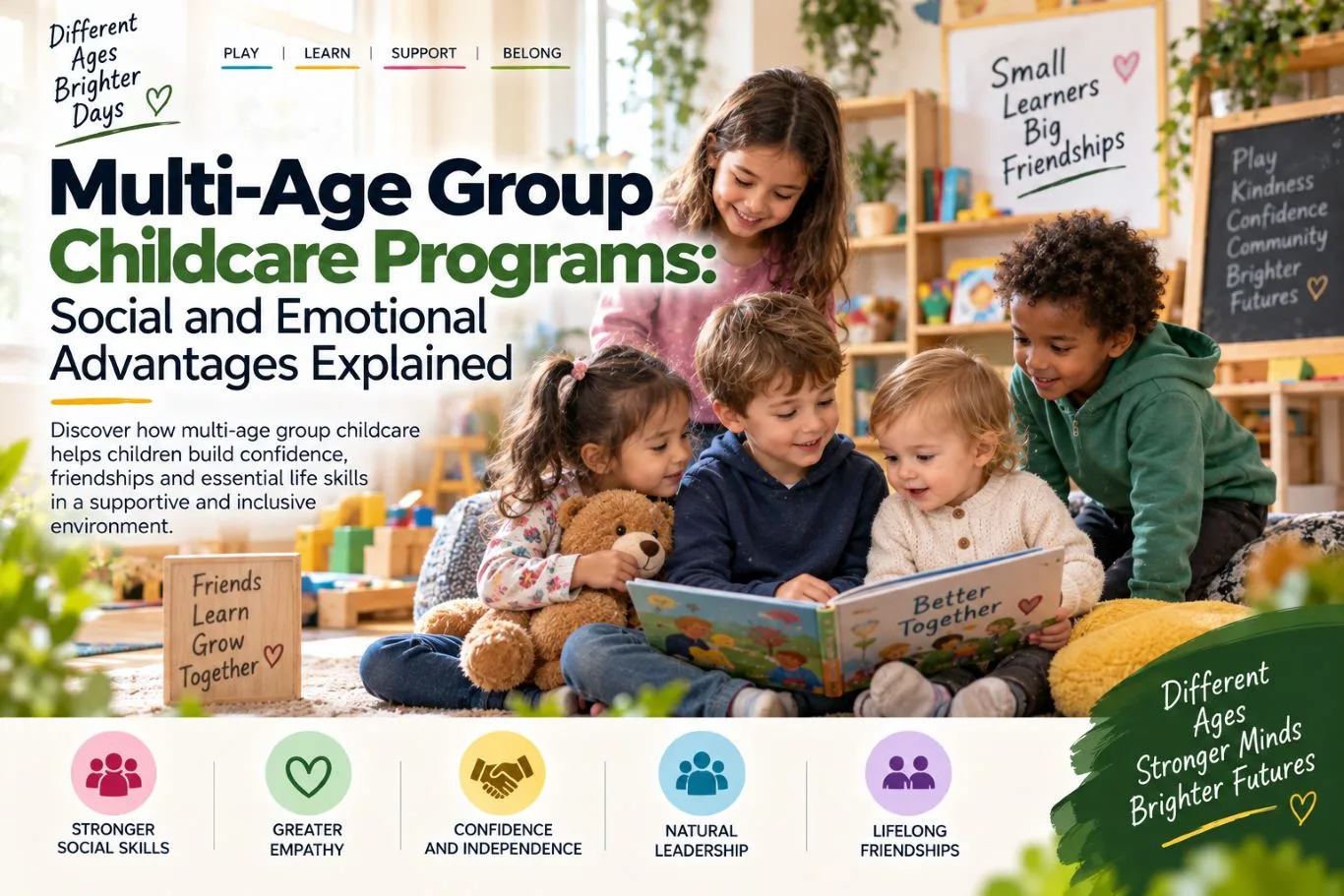
- Enrolling in multi-age group childcare programs mirrors real-world family dynamics, allowing children to learn, play, and grow alongside peers of varying developmental stages.
- Younger children rapidly build advanced language, problem-solving, and emotional regulation skills through natural peer observation and modeling.
- Older children develop authentic empathy, patience, and leadership qualities by guiding and supporting their younger classroom friends.
- Mixed-age environments dramatically reduce competitive social pressures, giving each child the freedom to progress at their own organic pace.
- Sandbox Station Childcare Centre offers a specialized Multi-Age Program (2.5–5 Years) in Surrey, BC, delivering high-standard, licensed, and deeply nurturing care.
Introduction
When parents begin searching for an early learning space, the traditional classroom model often comes to mind: twenty toddlers of the exact same age grouped together in one room, following an identical curriculum. Yet, when you look at how children naturally play in family living rooms, neighbourhood parks, and community gatherings, rigid age segregation disappears. Young children are drawn to older role models, while older kids instinctively step up to comfort, teach, and protect younger companions. For families across British Columbia, multi-age group childcare programs offer an enriching educational approach that embraces this organic way of learning. Rather than placing children on an arbitrary developmental conveyor belt, mixed-age classrooms create a supportive, community-centered environment where social-emotional growth blossoms naturally. Choosing a dedicated provider of multi-age group childcare in Surrey BC ensures your child experiences this family-style care within a licensed, professional setting. At Sandbox Station Childcare Centre, our dedicated Multi-Age Program (designed for children aged 2.5 to 5 years) is purposefully structured to cultivate empathy, confidence, and lifelong friendships under the guidance of passionate early childhood educators.
Ready to join an inclusive, enriching multi-age program tailored for your child’s holistic growth? Reserve your spot with our caring team today :
1. The Power of Family-Style Learning: Why Mixed Ages Matter
The philosophy behind mixed-age early education is rooted in human biology and cultural history. For centuries, children learned within extended family networks, absorbing language and social norms by observing older siblings, cousins, and neighbors.
Modern educational psychology validates this natural dynamic. Lev Vygotsky’s foundational concept of the “Zone of Proximal Development” illustrates that children learn most effectively when supported by a “more knowledgeable peer.” In a single-age classroom, all children share similar capabilities and emotional blind spots. In contrast, an intentional multi-age group childcare program bridges developmental stages seamlessly.
Younger Children Observe & Imitate ➔ Older Children Guide & Model ➔ Shared Cooperative Play ➔ Mutual Emotional Resilience
By bringing children aged 2.5 to 5 years together into one cohesive community, the classroom mirrors a close-knit family. Younger children see real-time examples of what their future skills will look like, while older children gain practical opportunities to mentor, lead, and practice genuine patience.
2. Emotional Development in Early Childhood: Eliminating Comparative Pressure
One of the greatest, yet rarely discussed, benefits of mixed-age groups is the relief it brings from peer comparison. In a standard classroom where every child is precisely three years old, developmental differences are often magnified. A three-year-old who is still building verbal fluency or working through potty-training milestones may feel subtle internal pressure or frustration when surrounded exclusively by peers expected to do the exact same thing at the exact same moment.
Valuing the Individual Journey
In a mixed-age setting, developmental variation is the expected norm, not an exception. Because the room naturally accommodates children ranging from 2.5 to 5 years:
- A child who excels intellectually can engage in complex storytelling or early literacy games with older peers without being held back.
- A child who requires extra time to build gross motor coordination or self-help skills can play comfortably alongside younger friends without feeling inadequate.
- Children measure their success against their own progress rather than a rigid, standardized timeline.
This relaxed, supportive atmosphere fosters deep emotional development in early childhood. Children build authentic self-esteem because they are valued for who they are, significantly lowering classroom anxiety and behavioral friction.
3. Social Skills Development in Children: The Dual Benefits of Mentorship
The social ecosystem of a multi-age classroom creates distinct developmental advantages for every age bracket involved.
How Younger Children Flourish (Ages 2.5 to 3.5)
Younger learners in a multi-age room experience accelerated growth across multiple developmental domains:
- Advanced Language Acquisition: Immersed in an environment rich with the complex vocabulary and expressive storytelling of older children, younger kids naturally expand their verbal fluency far faster than in single-age rooms.
- Complex Imaginative Play: While two-year-olds often engage in parallel play, watching four- and five-year-olds design elaborate dramatic play scenarios (such as building an airport or running a pretend bakery) inspires younger children to step into collaborative, imaginative roles earlier.
- Positive Emotional Regulation: When younger children witness an older peer handle a sharing dispute calmly or follow clean-up routines independently, they internalize these positive behavioral patterns through imitation.
How Older Children Excel (Ages 4 to 5)
For older preschoolers, the multi-age environment provides leadership opportunities that traditional classrooms simply cannot replicate:
- Practicing Compassion and Empathy: When a 2.5-year-old sheds tears at morning drop-off, older children naturally reach out to offer a comforting toy, hold a hand, or show them where the books are kept.
- Mastery Through Teaching: There is no better way to solidify a skill than by explaining it to someone else. Whether helping a younger classmate zip up a jacket or demonstrating how to hold paintbrushes, older children deepen their own cognitive understanding through teaching.
- Developing Authentic Self-Confidence: Being looked up to as a capable, respected role model nurtures a deep sense of responsibility and pride, preparing older children for the social dynamics of kindergarten.
4. Peer Learning in Early Childhood: Conflict Resolution and Social Harmony
Peer conflict is a natural, necessary component of early childhood. How children learn to navigate sharing, boundaries, and differing desires establishes their social foundation for life.
Dynamic Conflict De-Escalation
In single-age classrooms, conflicts frequently escalate because both children may lack the verbal and cognitive tools needed to negotiate. In a multi-age room, peer learning in early childhood changes this dynamic.
Sharing Dispute Arises ➔ Older Peer Demonstrates Compromise ➔ Educator Scaffolds Dialogue ➔ Empathetic Resolution Achieved
Older children often act as informal mediators. They can articulate feelings, suggest compromises (“You can have the blue truck when I count to ten”), and model turn-taking. Certified Early Childhood Educators (ECEs) guide these interactions, encouraging older children to voice their boundaries while showing gentleness to emerging learners.
The Breakdown of Peer Bullying and Exclusion
Research demonstrates that mixed-age childcare configurations experience significantly lower rates of aggressive peer behavior. Because the classroom environment is inherently collaborative rather than competitive, hierarchical cliques rarely form. Children view each other as partners in play, fostering an inclusive community where kindness and helpfulness are celebrated.
5. Continuity of Care: The Power of Long-Term Attachments
One of the most disruptive aspects of standard childcare models is the constant classroom turnover. Every time a child has a birthday, they are often graduated into a new room with different educators, unfamiliar routines, and new peer groups, forcing them to re-establish secure attachments.
Deep, Unbroken Relationships
In a multi-age configuration, a child enters the program at age 2.5 and can remain within the exact same nurturing environment until they graduate to kindergarten at age five. This stability offers profound developmental advantages:
- Enduring Educator Bonds: Educators have years, not months, to understand your child’s learning style, sensory sensitivities, temperament, and strengths.
- Deep Parental Partnerships: Parents build lasting relationships with the teaching team, fostering open communication and consistent guidance between home and classroom.
- Long-Term Friendships: Sibling-like bonds form between children, providing emotional stability and a deep sense of belonging.
Single-Age vs. Multi-Age Classrooms: A Clear Comparison
Understanding how multi-age learning differs from traditional, single-age childcare models helps parents evaluate the right fit for their household:
| Developmental Element | Traditional Single-Age Classrooms | Multi-Age Group Childcare Programs |
| Social Structure | Homogeneous peers; potential for heightened comparison and competition. | Diverse age spectrum (2.5–5 yrs); natural mentorship and family-style cooperation. |
| Language Exposure | Restricted to the verbal vocabulary of one narrow age bracket. | Rich, multi-tiered language immersion driven by older peers. |
| Role Fluidity | Children maintain a static age identity throughout the school year. | Children transition organically from being nurtured learners to capable leaders. |
| Educator Attachment | Annual classroom transitions with frequent educator changes. | Consistent, multi-year bonds with the same core educator team. |
| Pacing of Milestones | Standardized milestones based strictly on biological age. | Individualized developmental timelines respecting organic child growth. |
6. How Multi-Age Classrooms Prepare Children for School and Life
Parents sometimes ask whether a mixed-age setting adequately prepares an older child for the structure of formal elementary school. The answer is a resounding yes.
Kindergarten teachers consistently report that academic readiness is only half the battle; social-emotional maturity is what truly determines a child’s school success. An older child who has spent years in an intentional multi-age setting arrives in kindergarten equipped with:
- High emotional regulation and patience.
- The ability to collaborate comfortably with diverse personalities.
- Confident self-advocacy and problem-solving skills.
- The focus to work independently while remaining mindful of others in the room.
These core competencies form the foundation of lifelong resilience, allowing children to transition into elementary school classrooms with confidence and joy.
A Welcoming Early Learning Space for Surrey Families
Surrey is a dynamic, growing community where modern families need accessible, compassionate, and trustworthy childcare partnerships. From the quiet suburban streets of Fleetwood and Clayton Heights to the active corridors of North Surrey, parents want an early learning space that feels like a true extension of their home.
Finding a dedicated multi-age daycare in Surrey BC that balances play-based discovery with professional care gives families true peace of mind. Facilities like Sandbox Station Childcare Centre are deeply committed to delivering customer-focused, high-caliber early childhood education. Our Multi-Age Program (2.5 to 5 Years) is thoughtfully designed to nurture every child’s intellect, character, and social-emotional confidence, ensuring that your little one’s early learning journey is safe, enriching, and filled with wonder.
FAQs for Local Parents
Q1: How do educators ensure older children aren’t held back by younger classmates?
A1: Certified educators utilize open-ended, scaffolded activities. During an art or science exploration, a 2.5-year-old might focus on tactile sensory textures and primary colours, while a 4.5-year-old is guided to create complex patterns, write letter sounds, and count materials, ensuring both children are challenged at their appropriate level.
Q2: Will my younger child be overwhelmed or pushed around by older kids?
A2: No. In licensed multi-age settings, strict provincial educator-to-child ratios are maintained at all times. Educators guide older children to act as protective, gentle mentors, creating a classroom culture centered on kindness, respect, and cooperative play.
Q3: What neighborhoods do you serve, and how quickly can we set up a facility visit?
A3: We welcome families from across Surrey and surrounding BC communities. Because multi-age childcare spaces fill quickly across the Lower Mainland, we prioritize an efficient local response time, aiming to answer all tour and program inquiries within 24 to 48 business hours.
Q4: Can siblings be enrolled together in the multi-age program?
A4: Yes! One of the greatest practical benefits of a multi-age program (2.5–5 years) is that siblings can learn and play within the same room. This provides deep emotional comfort, eases morning drop-off anxiety, and simplifies daily logistics for busy parents.
Q5: Are multi-age programs in British Columbia eligible for provincial childcare fee subsidies?
A5: Yes. Fully licensed multi-age childcare programs participate in the Child Care Fee Reduction Initiative (CCFRI), which automatically reduces monthly parent fees on your invoice, and eligible families can apply for the income-tested Affordable Child Care Benefit (ACCB).
Conclusion: Setting the Foundation for Lifelong Confidence
Choosing the right early childhood environment is an empowering investment in your child’s future. By embracing the rich social dynamics of multi-age group childcare programs, you offer your child an educational setting that values individuality, fosters genuine empathy, and cultivates natural leadership skills.
When you partner with a center that combines high safety standards with authentic emotional warmth, daily drop-offs become moments of shared confidence and calm. If you are seeking a supportive early learning space where your child can thrive alongside a close-knit group of peers, Sandbox Station Childcare Centre is ready to welcome your family. We are proud to provide the trustworthy, accessible, and high-quality early childhood programs that Surrey parents rely on, ensuring your child’s early years are safe, inspiring, and joyful.
Give your child the lifelong advantage of a supportive, family-style learning community today :