
Quick Summary
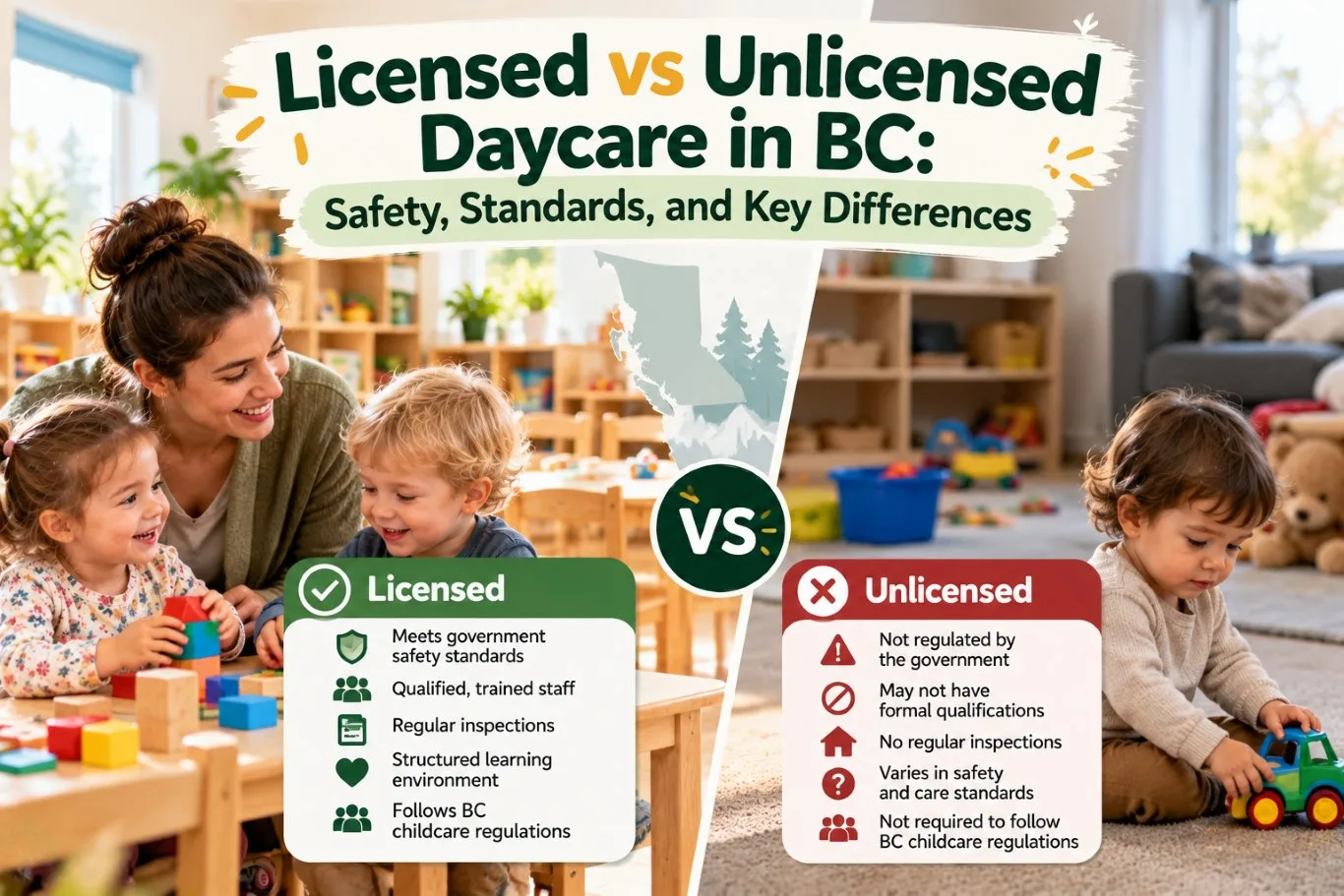
- Evaluating licensed vs unlicensed daycare in BC allows parents to understand the legal, safety, and developmental differences between regulated care and informal arrangements.
- Licensed facilities must meet rigorous provincial health, space, hygiene, and emergency infrastructure benchmarks overseen by regional health authorities like Fraser Health.
- Regulated centers employ certified Early Childhood Educators (ECEs) with verified background checks, first aid credentials, and mandated staff-to-child supervision ratios.
- Enrollment in a licensed center unlocks vital provincial fee-reduction programs, including the Child Care Fee Reduction Initiative (CCFRI) and the Affordable Child Care Benefit (ACCB).
- Sandbox Station Childcare Centre delivers licensed, dependable, and high-quality early childhood programs tailored to meet the needs of Surrey families.
Introduction
Searching for early childhood care can bring a wave of conflicting emotions for British Columbia parents. You want an environment that mirrors the warmth, safety, and attentiveness of your own home, yet you are also balancing practical realities like commute routes, waitlists, and monthly household budgets. During this search, you will inevitably encounter two distinct pathways: government-regulated centers and unregulated home arrangements. Navigating the debate of licensed vs unlicensed daycare in BC is about far more than bureaucratic paperwork; it directly impacts your child’s physical safety, emotional development, and daily peace of mind. Understanding provincial legislation, educator credential requirements, and facility standards is crucial when evaluating options for your family. If you are seeking a reliable, high-standard licensed daycare in Surrey BC, partnering with an accredited provider guarantees transparent accountability and proven early learning frameworks. At Sandbox Station Childcare Centre, we maintain strict regulatory compliance, ensuring that local families receive trustworthy, customer-focused early education where children feel safe, cherished, and inspired every single day.
Give your child the protection, certified guidance, and peace of mind that only a fully licensed early learning environment can provide :
1. Defining the Legal Landscape: What Does “Licensed” Actually Mean in BC?
In British Columbia, child care is governed by the Community Care and Assisted Living Act and the Child Care Licensing Regulation. These statutory frameworks exist to protect the physical health, psychological safety, and developmental well-being of infants, toddlers, and young children.
A licensed daycare in BC is an early childhood facility that has undergone comprehensive, mandatory inspection and approval processes through regional health authorities, such as Fraser Health or Vancouver Coastal Health.
Regional Health Authority Audit ➔ Facility Safety Certification ➔ Certified Educator Oversight ➔ Continuous Unannounced Inspections
Licensing officers evaluate every facet of operation before a facility can open its doors:
- Physical indoor floor space per child (minimum 3.7 square metres of clear play space per child).
- Dedicated outdoor play area sizing (minimum 7 square metres per child) with compliant impact-absorbing surfaces.
- Architectural safety, natural lighting, heating ventilation, and washroom fixtures designed for child autonomy.
- Comprehensive emergency evacuation, earthquake readiness, and fire protection protocols.
Unlicensed or “license-not-required” (LNR) operators, by contrast, are legally permitted to care for only two children or one sibling group unrelated to the caregiver. They operate completely outside government oversight, meaning no health authority officer ever visits the space to inspect sanitation, evaluate safety hazards, or audit supervisory standards.
2. Staff Qualifications and Educator Training Standards
The adults guiding your child through their early years shape their foundational cognitive and emotional architecture. The gap in caregiver qualifications between licensed and unlicensed settings is one of the most vital distinctions parents must weigh.
Rigorous Standards in Licensed Settings
To meet BC daycare licensing requirements, staff must hold official credentials verified by the BC Early Childhood Educator (ECE) Registry:
- Post-Secondary Early Childhood Credentials: Lead educators complete intensive academic training in child psychology, neurodevelopment, language acquisition, and inclusive curriculum design.
- Vulnerable Sector Screening: Every staff member, assistant, and substitute must pass a comprehensive criminal record check through the Ministry of Public Safety and Solicitor General before interacting with children.
- Active Pediatric First Aid: Caregivers must maintain valid CPR and emergency medical certification tailored specifically for infants and young children.
- Ongoing Professional Development: Certified educators must complete regular continuing education hours to maintain their professional license and keep pace with modern developmental science.
The Reality of Unregulated Childcare
In an unlicensed home setup, the provider is not legally required to hold any formal early childhood education, CPR training, or medical certification. There is no regulatory mandate requiring criminal background checks for the provider, their spouse, adult children, or regular visitors who enter the home while children are present. While an unlicensed caregiver may be warm and well-intentioned, parents must rely entirely on trust, with zero formal verification of the caregiver’s professional competency.
3. Supervision and Daycare Staff-to-Child Ratios in BC
Supervision is the cornerstone of child safety. An educator cannot respond effectively to an emergent safety hazard or provide individualized comfort if they are supervising too many children across incompatible developmental stages.
British Columbia mandates clear, legally enforceable daycare staff-to-child ratios in BC for licensed facilities:
| Program Type | Age Category | Educator-to-Child Ratio | Maximum Group Size |
| Infant/Toddler Care | Birth to 36 months | 1 Certified ECE to 4 Infants | 12 Children |
| Group Childcare (3–5 Years) | 30 months to School Age | 1 Certified ECE to 8 Children | 25 Children |
| Multi-Age Childcare | Birth to 12 years | 1 Certified ECE to 8 Children | 8 Children |
| Preschool Programs | 30 months to School Age | 1 Educator to 10 Children | 20 Children |
These ratios ensure that when an infant needs bottle-feeding, an educator can hold them securely without leaving other children unmonitored.
In unlicensed environments, a single provider often juggles their own children alongside minding daycare kids. If the caregiver falls ill, needs to use the washroom, or steps away to cook lunch on a hot stove, children may be left momentarily unattended—a risk factor that licensed centers systematically prevent through dedicated float staff and team coverage.
4. Safety Standards, Facility Inspections, and Emergency Preparedness
Evaluating daycare safety standards in BC highlights another significant divergence between licensed facilities and unregulated homes.
┌───────────────────────────────────────┬───────────────────────────────────────┐
│ Licensed Daycare │ Unlicensed Care │
├───────────────────────────────────────┼───────────────────────────────────────┤
│ • Unannounced health inspections │ • Zero official health oversight │
│ • Secure, keypad-controlled entry │ • Standard residential door locks │
│ • Child-proofed plumbing & outlets │ • Unverified residential hazards │
│ • Practiced fire & earthquake drills │ • No mandated emergency drills │
│ • Strict non-toxic sanitation rules │ • Variable domestic cleaning habits │
└───────────────────────────────────────┴───────────────────────────────────────┘
Ongoing Health Authority Audits
Licensed centers are subject to unannounced inspections by Fraser Health Licensing Officers. These officers inspect daily attendance logs, verify food preparation safety, audit hot water temperatures, inspect outdoor playground equipment for pinch points, and examine cleaning protocols. Public inspection reports are accessible online, offering parents complete transparency into a center’s compliance history.
In an unregulated setting, no external inspector ever assesses whether smoke detectors work, whether chemical cleaners are locked away, or if window cords present strangulation hazards. The safety of the environment rests entirely on the personal vigilance of one individual.
5. Educational Frameworks: Play-Based Learning vs. Passive Babysitting
Childcare should provide an active developmental foundation, not merely custodial supervision.
Licensed programs design their daily curriculum around the British Columbia Early Learning Framework. Early Childhood Educators transform open-ended materials into intentional cognitive provocations:
- Early Literacy & Communication: Interactive dialogic storytelling, phonetic rhyming games, and vocabulary expansion.
- Spatial Mathematics & Science: Tactile sensory tables, block architecture, pattern recognition, and nature inquiry.
- Social-Emotional Competence: Teaching positive peer conflict resolution, self-regulation, empathy, and classroom citizenship.
Unregulated childcare rarely operates with an intentional educational curriculum. Daily hours are frequently occupied by free-roaming domestic play or extended television and tablet screen time to keep children occupied while the caregiver manages domestic chores.
6. Financial Reality: Government Subsidies and True Affordability
A common reason parents consider unlicensed care is the initial sticker price. At first glance, an informal home caregiver may advertise a lower monthly base rate. However, when evaluating the broader financial picture, licensed care is frequently more affordable due to substantial government funding programs.
The Child Care Fee Reduction Initiative (CCFRI)
The Province of British Columbia provides direct operational funding to eligible licensed centers through the CCFRI. This initiative automatically discounts monthly tuition fees for parents—saving families hundreds of dollars per child each month without requiring complex paperwork. Unlicensed daycares are entirely ineligible for CCFRI funding.
The Affordable Child Care Benefit (ACCB)
Families earning up to $111,000 annually can receive additional monthly funding through the income-tested ACCB. While an unlicensed LNR provider can accept a modest portion of this benefit, licensed facilities qualify for the maximum allowable provincial subsidy rates. When provincial subsidies are applied, the net out-of-pocket cost for a licensed, professional center is often equal to or lower than unregulated alternatives, while delivering far superior care standards.
7. Reliability, Operational Stability, and Accountability
Every working parent knows the stress of a last-minute childcare cancellation. The structural stability of your provider directly impacts your job performance and daily routine.
Backup Staffing in Licensed Facilities
Licensed centers operate as structured organizations with teams of educators, administrative directors, and certified on-call substitute teachers. If a lead educator catches the flu or takes vacation leave, the classroom continues seamlessly with qualified backup staff. Parents are never left scrambling for emergency morning coverage.
The Vulnerability of Single-Caregiver Arrangements
Unlicensed care typically relies on a single individual. If that caregiver gets sick, attends a medical appointment, or takes a family holiday, the entire service shuts down. Parents are left to take unpaid days off work or rely on relatives to fill the gap. Furthermore, if a conflict arises over policies, deposits, or safety concerns, parents in unlicensed settings have no administrative board or regulatory authority to appeal to.
Direct Comparison: Licensed vs Unlicensed Childcare in BC
Use this detailed side-by-side guide when evaluating your child care choices:
| Key Operational Element | Licensed Child Care Centers | Unlicensed Child Care Providers |
| Provincial Health Oversight | Mandatory regular and unannounced health authority audits. | None; completely exempt from inspection. |
| Staff Qualifications | Certified ECEs with post-secondary credentials. | No early childhood training required. |
| Background Checks | Mandatory Vulnerable Sector Criminal Record Checks. | No legal background check requirement. |
| First Aid & Safety | Current Pediatric First Aid and CPR mandatory. | First aid training optional and unverified. |
| Staff-to-Child Ratios | Legally binding ratios enforced by law (e.g., 1:4 for infants). | Maximum 2 children (unregulated supervision). |
| Curriculum Approach | Grounded in the BC Early Learning Framework. | Informal babysitting; unmonitored screen time. |
| Provincial Subsidies | Fully eligible for CCFRI and top-tier ACCB subsidies. | Ineligible for CCFRI; minimal ACCB eligibility. |
| Operational Backups | Dedicated team with certified substitutes available. | Complete shutdown if the caregiver falls ill. |
Why British Columbia Families Prioritize Licensed Care
Choosing licensed childcare is an investment in your child’s emotional resilience, physical security, and long-term academic readiness. Regulated centers provide a transparent community where parents are treated as valued partners. From secure daily check-in protocols to open-door observation policies and regular developmental feedback, licensed programs give families the reassurance they need to focus on their workdays.
In a fast-growing, diverse city like Surrey, modern families need dependable childcare they can trust implicitly. Balancing long commutes across the Lower Mainland with career goals requires a service provider that never compromises on safety, hygiene, or certified care.
Community providers like Sandbox Station Childcare Centre take pride in offering customer-focused, licensed early childhood education. We understand that exploring licensed vs unlicensed childcare is about protecting what matters most. By maintaining clean, purposefully designed classrooms, low staff-to-child ratios, and play-based educational programs, we ensure local children thrive in an environment that is safe, enriching, and joyful.
FAQs for Local Parents
Q1: How can I verify if a daycare center is officially licensed in British Columbia?
A1: You can check the licensing status of any child care facility by searching the British Columbia Child Care Map or consulting Fraser Health’s public health protection directory. Every licensed center is also legally required to display their official provincial operating license in a clearly visible, prominent location near the front entrance.
Q2: Are unlicensed daycares in BC breaking the law?
A2: Not necessarily. In BC, an unlicensed caregiver is legally permitted to operate as a “license-not-required” (LNR) provider if they care for no more than two children, or one sibling group, who are unrelated to them by blood or marriage. However, if an unlicensed caregiver watches three or more unrelated children, they are operating an illegal, non-compliant child care operation subject to closure and fines by regional health authorities.
Q3: What neighborhoods do you serve, and how quickly can we set up a facility tour?
A3: We welcome families from all across Surrey and neighboring Lower Mainland communities. Because licensed early childhood spots are in high demand throughout the region, we prioritize responsive local communication and aim to answer all tour, waitlist, and registration inquiries within 24 to 48 business hours.
Q4: Do licensed daycares support children with diverse developmental needs?
A4: Yes. Licensed centers collaborate with provincial inclusion support programs, such as Supported Child Development (SCD). Certified Early Childhood Educators have the specialized training and community resources required to adapt physical spaces and learning activities so children of all developmental abilities can participate fully.
Q5: How do provincial subsidies lower the cost of licensed childcare compared to unlicensed homes?
A5: Because licensed centers participate directly in the Child Care Fee Reduction Initiative (CCFRI), monthly fees are discounted automatically on your statement. When combined with the income-tested Affordable Child Care Benefit (ACCB), the net monthly cost of licensed care often ends up being very comparable to—or even lower than—unregulated alternatives, while providing far greater safety and quality.
Conclusion: Making the Confident Choice for Your Child’s Future
Deciding on early childhood care is one of the most defining parenting choices you will make during your child’s first five years. By understanding the core distinctions surrounding licensed vs unlicensed daycare in BC, you can weigh regulatory oversight, educator qualifications, safety infrastructure, and financial subsidies with total clarity.
When you select a fully licensed early learning facility, you are not simply choosing a daily drop-off location; you are partnering with certified professionals committed to your child’s holistic development. If you are researching the licensed daycare benefits for parents and looking for an experienced, supportive early childhood home, Sandbox Station Childcare Centre is honored to welcome your family. We are proud to provide the trustworthy, accessible, and high-standard childcare services that Surrey parents depend on, ensuring your child’s early educational journey is safe, nurturing, and joyful.
Give your child the lifelong foundation of an expert-led, fully licensed early learning environment.
Make the informed choice today that sets the foundation for your child’s bright, confident tomorrow.